
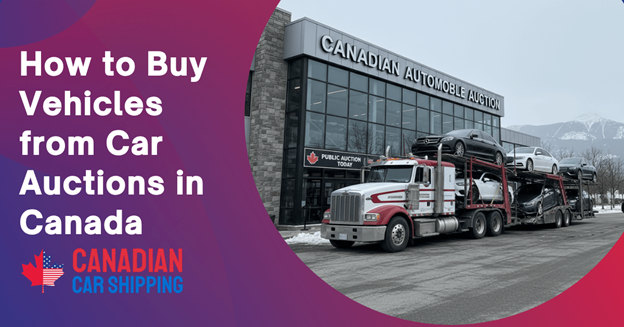
Auctions can help you save up to 30% when buying a car, if you know how to bid. But since there are different types of auctions with different rules, fees, and eligibility requirements, it’s a complicated process that requires much expertise and patience. Use this guide to learn about the full process of buying a vehicle from car auctions in Canada. Discover the actual steps for each process, any fees involved, and things to watch out for when buying a car in an auction.
Table of Contents
How to Buy a Car from Car Auctions in Canada?
The car buying process at an auction in general looks something like:
- Register
- Inspect cars
- Bid
- Pay within the time limit
But when you go into the details, the car buying process is different for different types of auctions. So firstly, you need to consider whether it’s a public auction, private, online, or government. Then, the vehicle buying process for each auction type differs accordingly.
For instance, in the case of a dealer-only auction, you need a dealer license to participate, but a public auction is open to everyone.
Once you purchase the vehicle, you’ll need it quickly moved from the Auction house or taken off from the hands of a private seller. That’s where we can help with our reliable auction car transport coordination service, call (888) 370-1041 to get a free no obligation quote today!
Car Buying Steps at Different Types of Auctions in Canada
In Canada, you’ll mainly come across these types of car auctions, and the steps to buy a car from each are somewhat different.
- Public Auction
- Private/Invite-Only Auction
- Online Auction
- Government Auction
Let’s go into the details to see how you can buy a car in each auction.
1. Public Auction
Public auctions are available to everyone of legal age. But some restrictions may apply depending on the auction. For instance, Manheim Auction Canada is open to everyone over 18 years of age. While the ADESA public auction requires bidders to have a valid driver’s license as well.
So conditions change depending on the auction and location as well. But in general, public auctions are available to everyone. Here’s the complete process to buy a car in public car auctions in Canada.
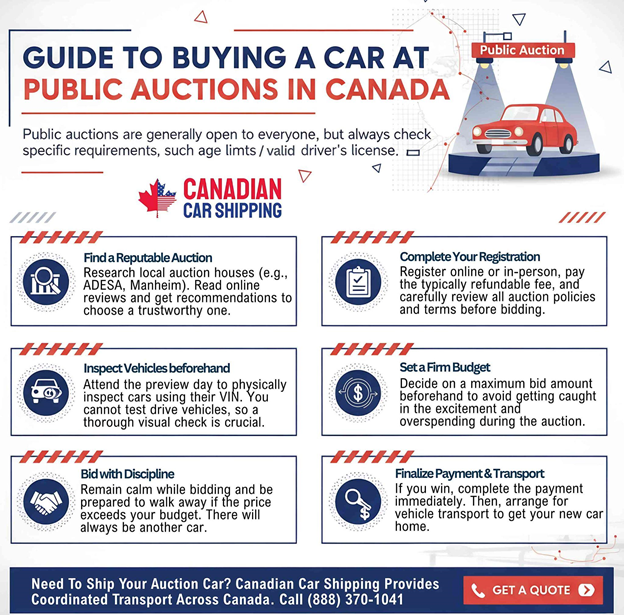
1. Research Auction Houses Near You
Firstly you need to look for reputable auction houses near you that hold public auctions. For instance, for the public auto auction Nova Scotia, ADESA is one of your options. But make sure you’ve read the online reviews, gone through relevant subreddits like r/askcarsales or r/usedcars, and consult your friends who attend these auctions often. The more you know about an auction house, the better.
2. Register in Advance
Next, register yourself either online or in-person to attend the auction. Pay registration fee, which is typically refundable; and make sure you’ve read the auction’s policies and terms and conditions carefully. Don’t miss adding all of your details.
3. Preview the Cars
On the preview day, inspect the car’s condition through its VIN number. Even though you can’t test drive a car, make sure you attend the preview day.
4. Set a Budget
Don’t forget to make a budget already. It’s very easy for buyers to get caught up in the excitement and overspend on the bidding day. However, if you set a budget, that’ll help.
5. Bid Strategically
The first rule you’ve to stick to while bidding is to keep calm and not rush. And second, always be prepared to move on, if that particular car goes out of your budget. There’s always another car to bid for.
But if you win, complete the purchase and arrange vehicle transport, especially if you have to move your car to another province. Canadian Car Shipping offers well-coordinated auction house car transport across Canada. Dial (888) 370-1041 to get started today!
2. Private/Invite-Only Auction
Private auctions are different from the public ones, as only those who are invited can attend and bid on the valuable car collections. These can be either exclusively dealer-only private auctions or just anyone who’s invited can attend.
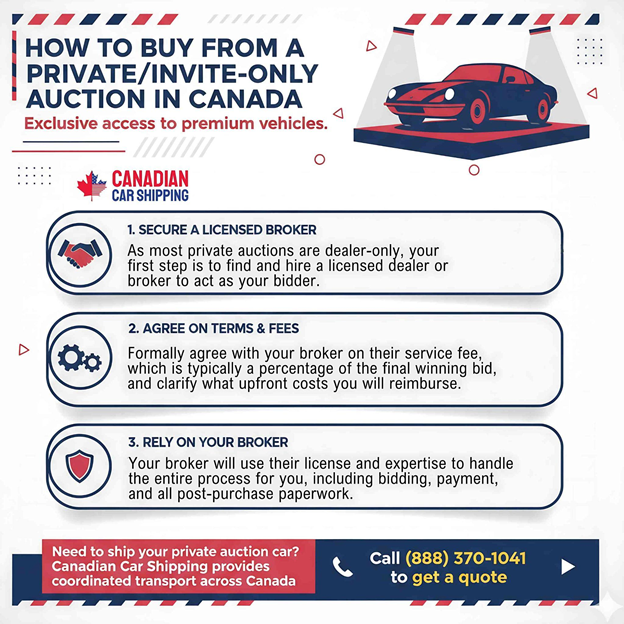
In most cases, you cannot attend or bid on cars directly in a private auction. Instead, you need a licensed car broker or dealership to bid on your behalf for a fee. But, if you’re a serious car collector or a high-end buyer, chances are you’ll get invited to these private auctions.
Keep in mind that since these auctions have the most desirable inventory and you’re only bidding against limited individuals, your bidding strategy should be top-notch.
So the buying process for most private car auctions in Canada involves mainly finding a licensed broker or dealer.
Since you need a dealer’s license to participate in most private car auctions, find yourself a licensed dealer or broker to handle the bidding on your behalf. They will charge a few percent of the winning price of the car and bid for your part.
But you also have to reimburse them for all the taxes and sometimes the auction registration fee is excluded. However, that’s all you have to do to bid at a private auction. Your dealer will handle the rest, including all the paperwork after purchase through their license.
3. Online Auction
Online auctions allow you to participate in auctions throughout the country and bid comfortably from the comfort of your home. So it doesn’t matter whether it’s automobile auctions Calgary or an auction in some other Canadian city; if it’s online, you can participate, bid, and purchase a car all while sitting at your home.
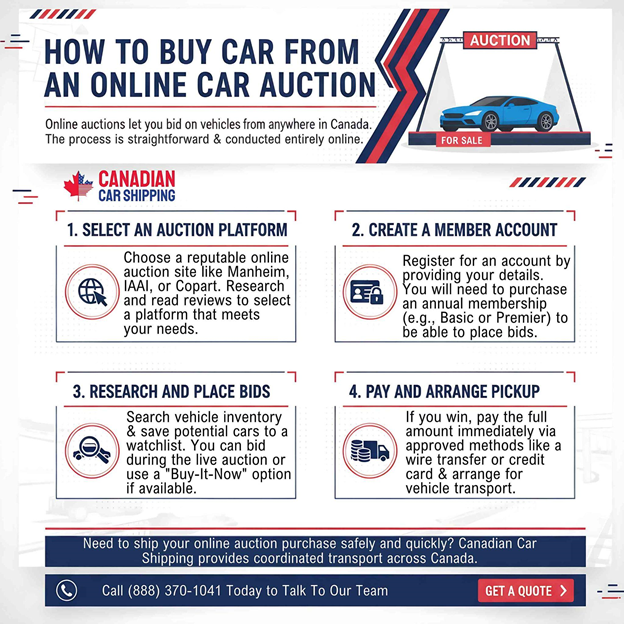
1. Choose a Platform
There are various online auction platforms in Canada where you can register and purchase a car. For example, Manheim, IAAI, or Copart. Read online reviews and choose a site that you think fits your needs.
2. Create an Account and Buy a Membership
Give your basic details like your name, email ID, driver’s license, age, etc. to create an account and then buy a membership to bid. You can choose between two membership options, basic and premier. Basic is for the beginners, and Premier is for the frequent buyers.
For instance, the annual basic membership fee at Copart is $69 CAD, while the premier fee is $265 CAD annually. However, there’s a third option as well which is a guest membership, where you create a guest account for free and view auctions or get vehicle alerts.
3. Find and Bid on a Car
Once you’re a member, search the inventory and look for your potential car. Add make, model, or other criteria in the search function and save your potential cars to a watch list.
Then, you can either bid on those cars before the auction or during the live auction. You can also get lucky if the car you’re interested in has a buy-it-now option, as you can purchase it at a set price.
4. Select a Payment Method
If you win a bid, be ready to pay all the fees at once. Online auto auction platforms allow you to choose between a wire transfer or a credit card option, whichever is convenient for you. Lastly, arrange pickup for your vehicle and you’re good to go. Canadian Car Shipping offers well-coordinated online house car transport across Canada. Dial (888) 370-1041 to get started today!
4. Government Auction
Government auctions allow you to bid on government surplus vehicles, retired automobiles from government service, seized vehicles, or forfeited cars. You can find government auction websites like GovDeals and GC Surplus frequently putting up vehicles for bidding.
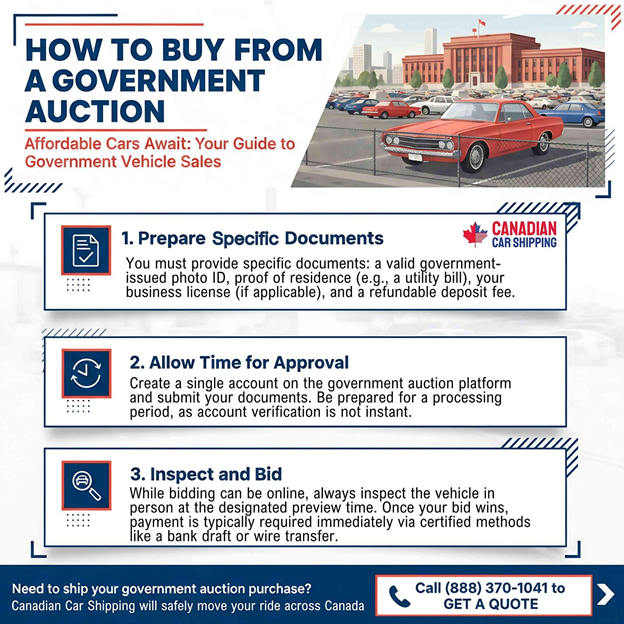
Government auctions allow both online and in-person bidding. In fact, you can also inspect the vehicle in person after online bidding, depending on auction rules and policies.
The rest of the bidding and buying process is almost similar to a public auction. However, the registration process at government auto auctions is specific. You need to submit:
- Your government-issued ID
- Pay a deposit fee
- Your business license
- Proof of residence
Make sure you only have one account at the government auction site.
And then, your account approval will take some time before you can start bidding. The rest of the process is quite standard. These auctions are a great source for budget-friendly buyers where they can find some reliable and affordable vehicles.
Remember, whether its automobile auctions Calgary or an online auction, steps to buy a car at each auction type are different; you need to know what you want and what’re doing for a successful purchase.
For instance, in public auctions, you need to find an auction house, register yourself, inspect cars, bid, and pay.
But, in a private auction, the car buying steps are different and you need to follow some other rules to complete the purchase.
Exercise patience, do thorough research, and place a calculated bid to get a valuable car at a competitive price.
3 Things to Watch Out For When Buying a Car At an Auction
Whether you’re buying a new car at an online car auction, Canada or at an in-person public auction, watch out for these 3 common mistakes many buyers tend to make.
1. Not Reading Auction Rules Thoroughly
There are different sets of rules for every auction, and if you don’t read auction rules thoroughly, you possibly end up with last-minute crises. For instance, some auctions do not sell cars with warranties and you’re responsible for any issues after purchase. If you do not check the auction rules beforehand and learn this later, it’s such a headache to deal with.
2. Bidding Impulsively
Many make the mistake of not setting a budget and bidding impulsively. Studies suggest that many bidders often overpay due to peer pressure or emotional triggers and then suffer through what’s called winner’s regret.

3. Underestimating Pre-Auction Research
Do not get drawn away by the excitement and skip your pre-auction research. It’s a very important point where you check your potential car’s history on platforms like CarFax or VinAudit and research its market price. Skipping this step will either push you towards an expensive purchase or you’ll end up buying a vehicle with too many hidden problems.
Canadian Car Shipping Offers Safe Vehicle Transport T/From Auctions:
Once you’ve bought the car, the next step is to ship it safely from the auction house as delaying can result in storage charges or in case of any damages discovered past the storage period, the auction house might not claim responsibility.
So it’s best to quickly get the vehicle off their hands and into your garage. Canadian Car Shipping can help you with that. Our carriers will coordinate with the auction house or the private seller, pick the vehicle, and bring it safely to you. Call (888) 370-1041 to discuss your specific requirements and custom quotes today!
