

According to Canada’s import statistics, C$50.3 billion worth of vehicles were imported in 2024, making autos the most-imported product (by value). Many ask: Are the car imports that Canada brings from the U.S. a smart move for ordinary buyers, or only work in niche cases?
Below we explore when and how importing a car from the U.S. makes sense, what are the costs and risks you’ll face and how it compares to the benefits.
Table of Contents
Is it Worth Importing a Car to Canada?
Importing a car to Canada is worth it if you are coming back from the US or moving here and want your trusty ride with you. But if you’re purely looking for a profit standpoint like buying cheap there and importing to save some bucks then it is rarely worth it for non-CUSMA-compliant U.S.-made models due to a new 25% surcharge (from April 2025) on many vehicles.
Total landed cost includes purchase price, shipping ($1,000–$3,000), duty (6.1% for non-US builds), GST/HST (5–15%), RIV fee ($325), and possible compliance upgrades ($100–$2,000). This surtax applies based on VIN origin, so checking the manufacturing country is critical.
How To Decide If Importing Vehicles into Canada is Suitable for You?
Importing cars into Canada depends on a few basic factors, so whether it is worth it for you can vary. In some cases, it may make sense; in others, it may not.
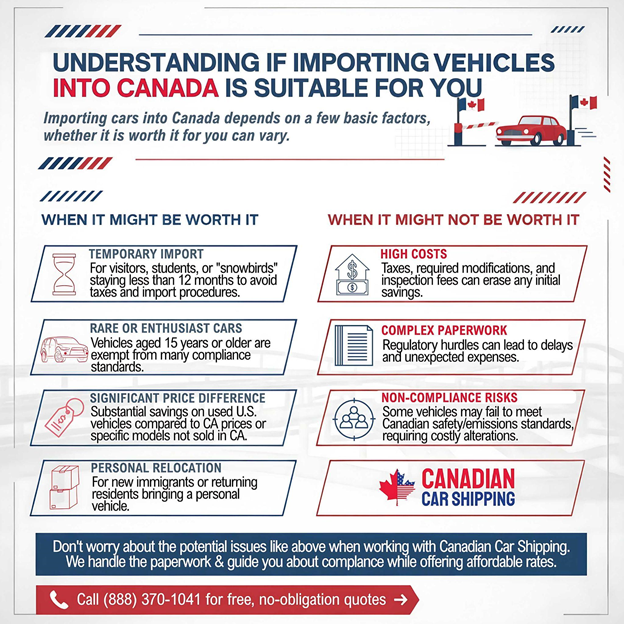
When it Might be Worth it
- Temporary Import: Snowbirds, vacation goers, and students and anyone else visiting for a period of less than 12 months doesn’t need to pay hefty taxes and can temporarily import the car.
- Rare or Enthusiast Cars: Vehicles 15 years or older are often exempt from certain standards and have fewer compliance requirements. Making them easier to import.
- Significant Price Difference: S. used cars sell for thousands less than similar models in Canada.
- Unavailable Models: At certain times, models or brands may not be sold in Canada. Importing them becomes a requirement.
- Personal Relocation: New immigrants or returning residents may import a vehicle for personal use.
When it Might Not be Worth it
- High Costs: Taxes, modifications, and inspections often cancel out savings.
- Complex Paperwork: Regulations can cause delays and unexpected expenses.
- Non-Compliance Risks: Some vehicles may fail to meet Canadian safety or emissions standards without costly modifications.
If you’ve decided to move your car from the US to Canada, we can help you understand the regulations, filing paperwork, and safely transporting your car from the US to Canada. Use our car shipping quote calculator for free, no-obligation transport quotes or call (888) 370-1041 to talk to one of our team members.
What If You Sell Your Current US Vehicle & Buy a Used Car in Canada?
That’s a good idea and some people do that as well. However, we recommend buying a new car in this case because of vehicle unfamiliarity.
Sometimes it’s not worth the risk to sell your current vehicle that you’re fully familiar with. You know its faults, repair and service history, and apparent and hidden issues in physical condition.
Unless you buy a new car, there’s always a risk of getting a used vehicle with lots of mechanical issues that might take more money out of your pocket than save you on shipping costs.
For instance, let’s say you sell your 2015 Honda accord in the US for USD $12,000 as per KBB estimates, as it was costing you USD $1,200 to ship to Canada plus any fees and taxes.
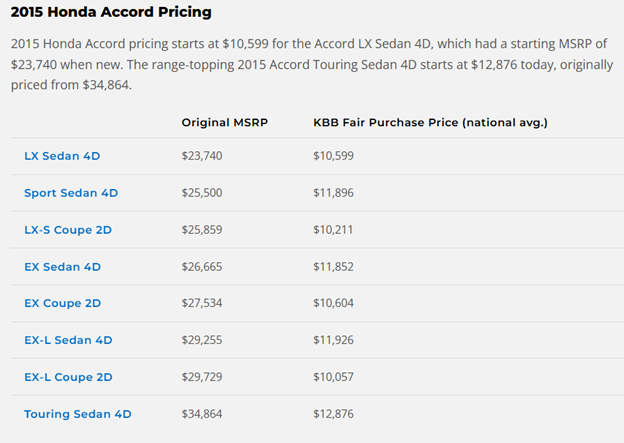
You plan to use the sale amount to buy a Honda Accord in Canada, which could cost you the same, within the range of $12,000 USD because used vehicles go for less when you sell and cost more when you buy. That’s a rule for everything because the dealer keeps his commission, and tax costs in the price. There are also title transfer fees as well so the difference isn’t much.
Now let’s say you do your full due diligence when buying this car, there’s still a very high chance there will be issues with it. That’s because AutoTrader found that 69% of people who bought used cars felt dissatisfaction and buyer’s remorse. They felt as if they had gotten a bad deal.
Though this study was done in 2014, not much has changed in people’s psychology since then. Someone telling lies to sell something is still quite common.
So there’s nearly a 70% chance you may get a bad deal. And if the car comes with hidden mechanical issues, you’ll likely spend $539 per visit for repairs as that’s how much it costs in Canada as of 2025. If you have to have the vehicle repaired 1-2 times a year, you’ll be paying way more in the long run than the cost of importing the car into Canada.
So if you want familiarity, no risk of any unwanted or unforeseen repairs, and avoid the overall risk of getting a bad deal on a car when you move to Canada, importing your existing vehicle is the right choice.
4 Essential Checks Before You Start Importing Car From US to Canada
Do these checks before buying or importing vehicles into Canada.
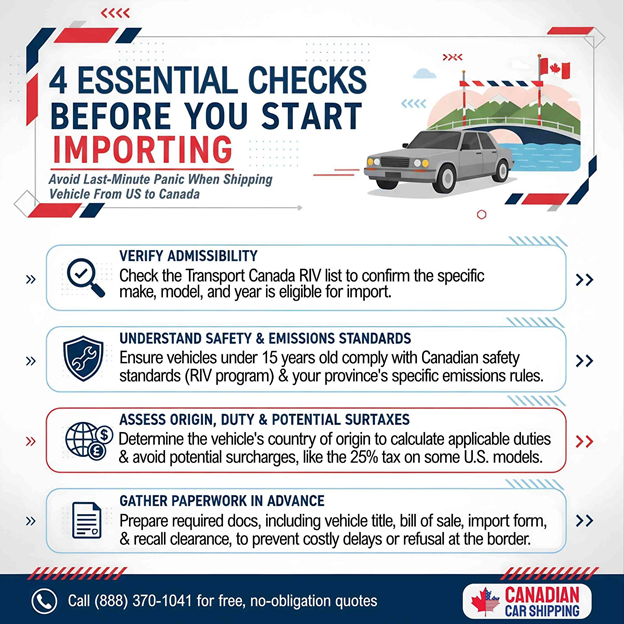
Verify Admissibility
Start by confirming that the specific make, model, and year of the vehicle are eligible for import. Transport Canada maintains the RIV/Transport Canada compatibility list, which outlines what can be registered and whether modifications are possible. If a vehicle isn’t listed, or if it’s marked as non-modifiable, it likely cannot be imported.
Understand Safety and Emissions Standards
Vehicles under 15 years old must comply with the Canadian Motor Vehicle Safety Act and usually fall into the Registrar of Imported Vehicles (RIV) program. However, emission rules are not uniform, and requirements vary by province. Reviewing both Transport Canada’s safety rules and your destination province’s emissions guidelines can help you gauge whether modifications will be needed, and what those might cost.
Assess Origin, Duty, and Potential Surtaxes
Import taxes can be affected by where the vehicle was manufactured. Under certain trade measures, vehicles of U.S. origin may attract a 25% surcharge in addition to applicable duties if the vehicle doesn’t meet CUSMA (formerly NAFTA) rules of origin. The Canada Border Services Agency (CBSA) provides notices and updates on current and duty rates. Checking the country of origin early helps avoid unplanned costs.
Gather Paperwork in Advance
Smooth car imports to Canada depend on complete and accurate documentation. At a minimum, you’ll need:
- The Vehicle Import Form
- A clear title of proof of ownership
- Bill of sale
- Recall clearance letter
- Proof of origin if you are seeking preferential tariff treatment
Missing or incomplete paperwork often results in delays, storage costs, or the need to re-export the vehicle.
Permanent US To Canada Car Import Costs You Should Know
Below is a breakdown of current real costs of car imports to Canada. You must estimate these before purchasing a U.S vehicle for import.

| Item | Note | Estimate / Rate |
|---|---|---|
| RIV registration fee | Charged for vehicles in the RIV program | C$325 |
| A/C excise tax | If the car has air conditioning | C$100 |
| Surtax (U.S. vehicles) | Applies since April 9, 2025 | 25% of value for duty |
| Import duty (non-CUSMA) | Applies when vehicles do not qualify under free trade rules. | 6.1% |
| GST | Collected at the border | 5% on total value + duty + surtax |
Other Variable Costs
- Modification (lights, wiring, speedometer, etc.)
- Safety repair costs (body, rust, mechanical)
- Transportation to border and shipping
- Broker or custom agent fees
- Provincial taxes and registration costs.
- Inspections, and modifications (like converting the speedometer to kilometers, adding daytime running lights).
Hidden Ongoing Costs
Costs do not stop once the vehicle clears the border. Imported cars often have long-term ownership expenses. Such as:
- Depreciating and Resale: Grey imports often sell for less because buyers worry about compliance and parts availability. A car that looks like a bargain, could possibly also lose thousands in resale value.
- Warranty Coverage: Manufacturers warranties issued in the U.S may not transfer to Canada. Owners may need to pay out-of-pocket for repairs and third-party warranties.
- Maintenance and Parts: S.-specific parts may not always match Canadian service networks. Wait times and shipping costs could add up significantly in the upkeep.
Factor in all these costs in your budget to provide a realistic picture of the total ownership.
4 Benefits that Make Importing Canada Worth it
Following are the real, measurable benefits that help justify all the efforts of importing vehicles to Canada from the U.S.
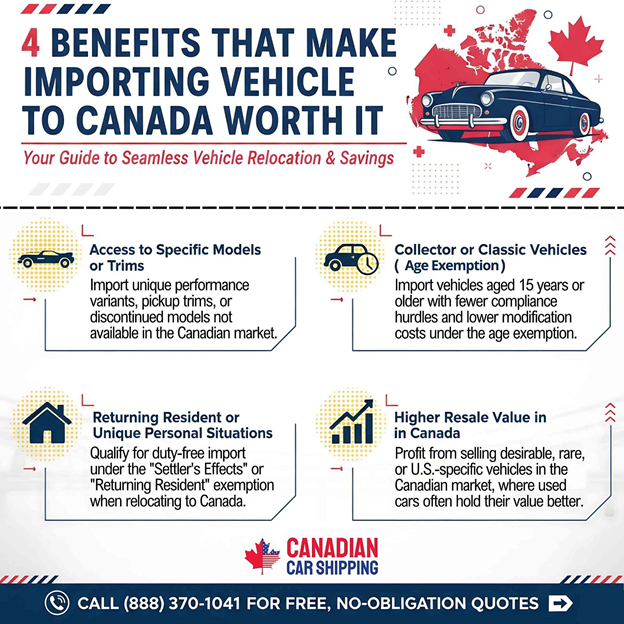
Access to Specific Models or Trims
Some vehicle trims, options, or speciality models are not sold in Canada. For example certain performance cars, pickup variants, or discontinued models. If the model has unique value to you, import may be the only route.
Collector or Classic Vehicles (Age Exemption)
Vehicles that are 15 years or older face fewer federal compliance hurdles and often avoid the RIV program’s full modification burden. This lowers the cost and improves feasibility.
Returning Resident or Unique Personal Situations
If you are relocating and the vehicle is part of the household goods or personal effects, there are specific rules and exemption. For instance, if you are a Canadian living abroad for more than a year you can bring your personal vehicle duty-free under the Settler’s or Returning Resident’s exemption.
Higher Resale Value in Canada
If you obtain a desirable or distinctive vehicle that is not available domestically or for individual use, you can resale it once imported. Used cars in Canada tend to hold value better than the U.S. That way, importing certain vehicles can result in a higher resale value once registered in Canada. The difference of prices or currency exchange rates become profitable upon importing.
6 Risks and Potential Pitfalls of Importing Vehicles Into Canada
Importing may expose you to some predictable and costly failures. Treat every point below as a hard check.
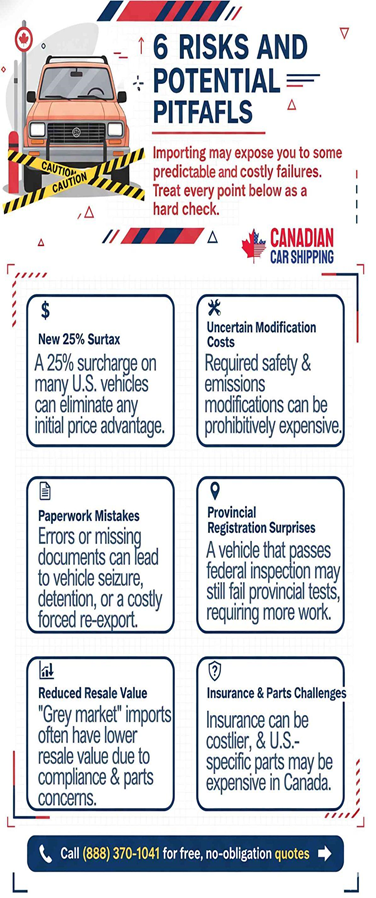
New 25% Surtax Creates a Reduced Price Benefit
Since April 2025 CBSA applies a 25% surcharge on many U.S origin vehicles. This alone wipes out any modest price advantage. Always check CBSA notices for the latest coverage and exclusions.
Modification Costs Are Uncertain
Required changes (lights, speedometer, tethers, emissions) can be inexpensive for some cars and very expensive for others. Structural repairs or rust work can make a purchase uneconomic. Transport Canada warns that not all vehicles can be modified.
Paperwork Mistakes can Cause Seizure or Forced Return
Incorrect or missing Form-1, title, or recall clearance can lead CBSA to detain a vehicle until corrected or require re-export. The time and cost to re-export are often large and can outweigh the benefits.
Canadian Car Shipping solves this issue by taking documentation and paperwork filing into our own hands. We do this for hundreds of customers on a daily basis so we know exactly what’s required.
Provisional Registration Surprises
Provinces enforce unique testing. A car that passes RIV may still require additional provincial emissions or mechanical work at registration. Check your province’s licensing authority before import.
Market Value and Resale Risk
Imported cars sometimes resell at a discount because buyers worry about compliance or future servicing. Factor in reduced resale value for grey imports.
Insurance and Parts Availability
Some models cost more to insure, and parts may be harder to source if the model is rare in Canada. It is important to ask insurers and local shops before purchasing.
Can You Import Other Types of Vehicles?
Yes but international shipping rules differ by vehicle type. Handle each import separately, even if it’s two different types of cars, motorcycles, boats, etc.
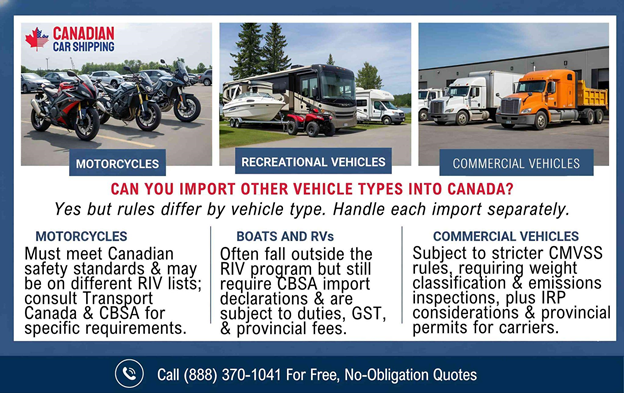
Here’s what you need to know:
- Motorcycle shipping in Canada is common but still may require paperwork and inspections. They must meet safety standards and may be on different RIV/admissibility lists. For shipping and cross-border registration specifics, consult Transport Canada and CBSA.
- Boats and RVs may fall outside the RIV program (especially if not connected to a trailer or vehicle) but still CBSA import declarations might attract duties, GST and provincial fees. CBSA offers guidance for all vessels and recreational vehicles.
- Commercial vehicles such as trucks, vans and buses have different rules compared to personal vehicles. Their rules are stricter and also require weight classification, emissions and modifications inspections from Canadian Motor Vehicle Safety Standards (CMVSS). As a carrier, you also need to prepare for International Registration Plan (IRP) considerations, licensing requirements, and provincial permits.
Reversing the Direction: Importing from Canada to the U.S.
If you plan to import a car to the U.S from Canada, or sell a Canadian vehicle into the U.S., U.S rules apply. The U.S requires:
- EPA Form 3520-1
- DOT Form HS-7
- Compliance with NHTSA/FMVSS standards
Older vehicles of 25 years or more may use relaxed NHTSA rules. If you want to do frequent imports from Canada into the U.S. it is best to check CBP, EPA and NHTSA before. Noncompliance can lead to refusal and high return costs.
Canadian Car Shipping Makes Car Imports Canada Stress-Free:
If you want to import your vehicle into Canada but avoid all the hassle of driving across the border, go through customs processes, and learn about all the documentation required, Canadian Car Shipping can help. We regularly help people cross the border to/from US-Canada, with 77% of our total shipments consisting of crossborder vehicle transports, so it’s a routine for us.
You’ll get the best fees and tax support, door to door vehicle transport, documentation preparation guidance and more with Canadian Car Shipping. Our experts handle everything for you, ensure you have your vehicle imported, cleared from customs, and ready for you to drive in Canada. Call (888) 370-1041 to get started today.
