
Shipping a vehicle from British Columbia to Newfoundland is Canada’s longest possible domestic auto transport route. The driving distance between these two provinces is almost 6,845 kilometers (including the ferry ride). Learn in this guide, how to ensure smooth vehicle shipping across Canada (from BC to Newfoundland).
Table of Contents
How Do I Ship My Car From British Columbia to Newfoundland?
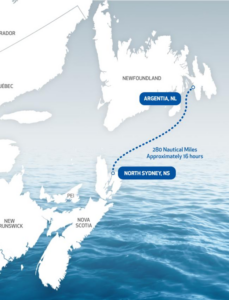
If someone is in BC, their goal is to first get the car to North Sydney, Nova Scotia. That can either be done by rail or by truck through the Trans Canada highway. Then from there, the vehicle is loaded onto a Ferry destined for Port of Argentia (the summer priority) or the Port of Port aux Basques (the year-round route), with former being the first priority as the latter is notorious for its strong winds, causing delays.The ferry drops the vehicle onto either of these Newfoundland terminals and then from there it is delivered to customers by truck.
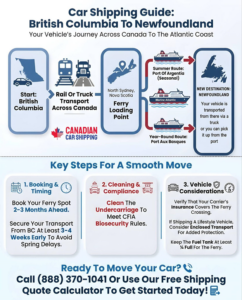
For smooth vehicle shipping from BC to Newfoundland, you must clean the car undercarriage thoroughly to meet CFIA biosecurity measures, and ensure you book your Marine Atlantic ferry slots 2-3 months in advance. Also, to avoid the May rush in BC, book your shipments at least 3-4 weeks in advance. Confirm if your carrier offers insurance coverage for the ferry crossing. Plus, since most BC shipments involve lifestyle vehicles (8.2%), ensure you choose enclosed transport like the 20% of the BC shippers. And make sure the car fuel tank is at least ¼ full for the ferry crossing.
Ready to move your car? Call (888) 370-1041 or use our free shipping quote calculator to get started today!
How to Ship Your Vehicle Smoothly from BC to Newfoundland?
Follow these inside tips for a smooth car hauling across Canada:
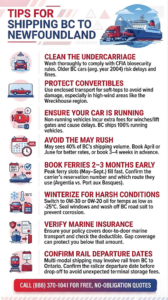
1. Deep Clean Your UnderCarriage (Especially for Older Cars)
As per our internal data, the average vehicle shipped from BC is 5 years older than the national average (Model year 2004 vs. 2009). And the oldest car we have shipped from British Columbia was a 1952 model. Therefore, since most BC cars are statistically older, it’s likely the undercarriage is covered with layers of dirt, oil, and organic matter.
And in vehicle shipping across Canada (especially from BC to NL), a car should be strictly clean and free from soil, plants, plant parts, and other related matter to comply with the CFIA biosecurity measures. Otherwise, your car can face delays at the terminal, refused pickups, and mandatory cleaning at your own cost. So make sure you power wash the undercarriage thoroughly in advance, and don’t give the inspectors at the border a reason to turn you away.
2. Double-Check Your Soft Top
Our internal data shows BC sends out double the percentage of lifestyle vehicles (Roadsters, Convertibles, Coupes) compared to the rest of Canada (8.2% vs. 3.9%). And special considerations are needed for these special cars. For instance, if you’re shipping a convertible (like the Daimler SP250 or Porsche 911s that we’ve shipped before), you need to be careful about the soft top.
Open transport for these vintage soft tops can be risky due to strong winds at highway speeds. The Government of Canada recently issued warnings for high winds (southeasterly 100km/h) in the Wreckhouse region (near Port aux Basques) and Cape Breton. So just like 20% of the BC shippers, choose enclosed transport for these rare classics. But if you’re on a tight budget, make sure your convertible top is latched securely and add a protective cover.
3. Don’t Be the “Non-Runner”
Given our internal data, all the cars that are shipped from BC are listed as ‘Running.’ In comparison, other provinces have a small percentage of non-running vehicles. That means, if you ship a non-running vehicle from BC to Newfoundland or any other province, you might be the only non-runner on that truck.
This can cause cost increase as the carrier might have to arrange for loading equipment such as winches or lift gates or even forklift depending on vehicle weight and size. Further, there will be potential delays in the loading and unloading or the carrier might have to arrange a specialized truck that wasn’t originally scheduled.
You will be charged a premium for the extra labor required in this case. Therefore, make sure your car has enough fuel for the loading and unloading, and if it’s an electric vehicle the battery must be 20-50% charged. Also, ensure the tires are inflated.
4. Avoid the “May Rush”
Our data shows a massive spike in outbound British Columbia shipments in May. Almost 40% of the province’s total shipment volume happens in May. It’s either the snowbirds returning late or summer relocations. For instance, summers in BC’s southern interior are the hottest in this region (temperatures can reach 30-40°C in June, July, and August).
So late spring (May) is BC’s peak shipping season. And if you want a smooth vehicle shipping across Canada, make sure you avoid the May rush in BC. Instead, you can ship in April or June. This will get you better rates with higher carrier availability.
Or if shipping in May is inevitable, make sure to book the shipment at least 3 to 4 weeks in advance.
5. Book Marine Ferry Slots 2-3 Months in Advance
We recommend booking your nationwide auto transport Canada service at least 2 to 3 months in advance, when ferry crossing is involved. And that practically makes sense, because May-September is the peak season for the ferry moves. You’re competing against commercial traffic, locals, tourists, and other Canadian auto transport companies. So slots vanish fast.
And then, if your shipper misses the Argentia window, which is from mid-June to late-September with just three sailings per week, they will have to use the Port aux Basques route, which adds an additional 902 km of driving across Newfoundland to reach St. John’s or the Avalon Peninsula. Ultimately, your vehicle arrives later than expected.
Canadian auto transport companies that specialize in the BC-Newfoundland route, book ferry slots in bulk during the off-season (October-April) for the following summer. So request confirmation of their ferry reservation number to verify they’ve already booked the crossing. Also, inquire in advance which ferry they plan to use (Port aux Basques vs. Argentia).
6. Prepare Your Car Appropriately When Shipping in Winters
Temperature in the inland areas of Newfoundland can drop as low as -25 °C during extreme winters. So if you’re shipping your car between October and March, prepare it properly before transport. For instance, weather-related delays like ferry cancellations can strand your vehicle in North Sydney for days or even a week during major storms.
In this situation, your vehicle sits in the sub-zero temperatures without being started. So make sure your vehicle is prepared accordingly. For instance, consider switching the motor oil from what BC drivers commonly use (5W-30 or 10W-30) to what Newfoundland’s weather demands (0W-30 or 0W-20). The ‘0W’ rating means the oil flows properly, even at -40°C.
Seal windows and all points of entry to ensure no snow or moisture can go inside. And don’t forget antifreeze either.
Or a more basic preparation that you can do is wash your car thoroughly to remove the existing salt from BC roads, as it can accelerate corrosion in Newfoundland’s harsh winter conditions. It’s better if you schedule a pre-shipping inspection specifically for cold-weather readiness.
7. Verify Insurance Coverage Across Marine Transport
Verify your vehicle has marine cargo insurance for the ferry crossing. Demand to see the actual policy language, and see if you’re being offered door-to-door coverage like the door-to-door car delivery Canada service. Many insurance policies have a “bill of lading transfer” clause that voids coverage when responsibility shifts from land carrier to ferry operator. So you need to make sure before you book a nationwide auto transport Canada service.
Also, make sure you confirm beforehand what their cargo insurance deductible is, and who pays for damage below that amount. Let’s say the deductible is $2,500, and your vehicle sustains $2,000 in damage during the ferry crossing, chances are you will have to pay for the damage out of your pocket.
In that case, you can buy a gap coverage that covers the deductible. Moreover, verify your personal auto insurance policy’s continuity from the Newfoundland port to your destination location. Harsh Newfoundland winters can damage your vehicle even in the protected trailers.
8. Confirm Rail Car Departure Date Before Drop Off
Mostly, affordable vehicle shipping Canada companies ship your vehicle through a multi-modal transport. That means, first your car gets shipped on an enclosed railcar via Annacis Auto Terminal on Annacis Island in Delta, BC, to Ontario. And then, from Ontario to Nova Scotia, your car gets transferred via road, followed by the ferry crossing to Argentia or Port aux Basques.
Now, in this shipping process, when your car is waiting at the Annacis Auto Terminal for loading and departure, after a certain free period allowed (as prescribed in the terminal’s tariff) storage or demurrage charges are applied. Sometimes, the waiting time at the auto terminal can be more than a week.
Cars wait in queues to be loaded onto the container/autorack, and there’s no departure until the container fills. In this situation, the storage fee keeps adding quickly, and this fee is not even included in the initial shipping quote. So make sure you confirm the railcar departure date before drop off.
Ready to move your car? Call (888) 370-1041 or use our free shipping quote calculator to get started today!
Marine Atlantic Ferry Requirements and Restrictions
Here are a few Marine Atlantic ferry requirements and restrictions that you should be aware of:
Vehicle Dimension and Weight Restrictions
Our internal data shows that the most common vehicles BC shippers move besides luxury sedans are their adventure vehicles (like Jeep Wrangler and Toyota 4-Runner, especially with aftermarket kits and modifications). But Marine Atlantic restricts oversize, overweight vehicles from sailing, and you require advance approval. That means, if you do not properly measure your car pre-shipping, this will potentially limit your ferry booking options during peak season.
According to Marine Atlantic’s commercial customer information, for units wider than 11’4’’ inches or greater than 90 feet in length, advance reservations are needed.
Completely Empty Vehicle Interior is Required
Marine Atlantic conducts security inspections before loading, and vehicles with loose items inside the car or cargo areas will be rejected or delayed for removal. That’s because during rough seas, loose items can become projectiles and damage your car’s interior, shatter windows, or injure the crew members when they’re accessing the vehicle deck.
Therefore, make sure there’s nothing inside your vehicle, and the aftermarket products (roof rack on an SUV) are securely attached to the vehicle.
Fuel Tank Must Be ¼ Full Only
According to Marine Atlantic’s Safety and Security Policies, vehicle fuel tanks should not be so full that they spill onboard. So a safe fuel tank capacity is one fourth. If your car is loaded with a tank full, there’s potential fire risk too.
Moreover, a ¼ full tank accounts for fuel expansion as temperatures fluctuate between the cool Maritime climate and the heated vehicle decks. Vehicles that arrive outside this required range may be refused boarding or required to add/drain the fuel at the terminal, causing delays and potential missed sailings.
At Canadian Car Shipping, we can help you safely move your vehicle from British Columbia to Newfoundland. Contact (888) 370-1041 or use our free shipping quote calculator to get started today!
How Time Zone Changes Affect Communication with Your Shipper?
Newfoundland operates on UTC-3:30 (a half-hour time zone that’s unique in North America), while most affordable vehicle shipping Canada services in BC operate on the Pacific Time zone. And Nova Scotia follows the Atlantic Time Zone. All of these different time zones create confusion between you and the shipper.
For instance, the carrier might send you the notification “expected delivery on Thursday at 3:00 P.M,” leaving you wondering whether it’s 3:00 P.M Atlantic Time Zone or the Newfoundland Time Zone. Therefore, you must confirm with the shipper about the time zone, so you won’t miss your delivery window entirely.
Also, it affects your real-time communication with the driver. Let’s say you call the driver at 9:00 AM Pacific Time thinking it’s early business hours, but it’s already noon Eastern. So it must be their lunch break and they might miss your call. Therefore, it’s very important to set clear expectations upfront about the communication window.
Canadian Car Shipping Offers Worry-Free BC to Newfoundland Car Transport:
Smoothly shipping your car across Canada’s longest domestic route (BC-Newfoundland) requires careful planning and consideration. It’s a complex multi-modal transport where you have to prepare your car for the rail car transport, highway shipping via trucks, and the ferry crossing from Nova Scotia to Port aux Basques/Argentia.
For instance, confirm the railcar departure date before dropping off your vehicle, so it won’t sit for too long at the Deltaport terminal. And then, ensure you book an enclosed trailer for your convertible at highway transport.
Choose an experienced carrier with proven BC-to-Newfoundland expertise to ensure your vehicle arrives safely and on time. At Canadian Car Shipping, we can help you safely move your vehicle from British Columbia to Newfoundland. Contact (888) 370-1041 or use our free shipping quote calculator to get started today!
Frequently Asked Questions:
What is the most cost-effective way to ship a car?
Open trailer shipping is the most cost-effective way to ship a car. According to Move.org, shipping on an open trailer costs $0.93 less per mile when compared to enclosed trailer shipping. Additionally, if you book early in advance and allow a flexible timeline for the pickup and drop-off, you can get cheaper rates.
How do I get my car to Newfoundland?
Transporting your car to Newfoundland requires a mandatory ferry ride that connects the island to the mainland. You can take this ferry from the town of North Sydney on Cape Breton Island in the province of Nova Scotia. Or simply hire a company for car hauling across Canada. They’ll handle this complex ferry crossing and mainland journey for you.
How much is the vehicle transfer fee in Newfoundland?
The price to ship a vehicle in Newfoundland depends on your origin location, distance, and whether you choose door-to-door car delivery Canada service or not. Also, carrier availability plays a big role in shipping prices. However, compared to the mainland shipping prices, vehicle shipping in Newfoundland is expensive. For instance, shipping from Vancouver to St. Johns can cost around $3,000 to $10,000.
How many days to drive to Newfoundland?
If you’ve decided to drive to Newfoundland how long it will take depends on your origin location. For instance, if you’re driving from Vancouver to Newfoundland and Labrador, the whole trip can take you 1 to 3 weeks, when accounting for all the driving time, rest, food, sightseeing, and the ferry ride.
What’s the best month to ship my car to Newfoundland?
The best month to ship your car to Newfoundland is either May or September. These months provide a perfect balance between good weather and lower shipping demand compared to the peak summer months (July-August). But when shipping on the BC-Newfoundland route, we’re mostly fully booked in May, so better reserve your space in advance.
