
Dealer To Dealer Auto Transport Canada is a facility without which dealerships would be in trouble while making a move either across the provinces or between different locations of the same city. As the inventory requirements change and the customer demand keeps evolving, dealerships thus, need to transport partners who are reliable to them so that they can relocate vehicles in a short period of time as well as in a safe manner. The distances between the Canadian cities are very often very long, and for this reason, it is not practical for the staff to drive the vehicles from one dealership to another.
Most dealerships are engaged in auctions, trade networks, and inter-dealer vehicle swaps. All these require the timely movement of vehicles which is a must if the logistics are dependable and well organized. Dealer To Dealer Auto Transport Canada is a means by which businesses can keep their inventory levels at a good level, move the fleets they have newly purchased, and get ready for the seasons when the demand will be high.
Table of Contents
Overview of Dealer-to-Dealer Transport Across Canada
Dealer-to-dealer transport is a dealer network service which is a very important part of the automotive businesses. It means the delivery of vehicles from one dealership to another, auction houses, commercial buyers, or storage lots. These are necessary movements for inventory balancing, dealership network expansion, and customer fulfillment. Transport companies decide whether to use open or enclosed carriers based on the vehicle type and the requirements of the dealership.
Open carriers are the cheapest way to transport and are good for a normal dealership stock of vehicles. In this manner, several vehicles can be transported at the same time. In the case of enclosed carriers, they provide extra protection to the high-end models, vintage vehicles, or units that are sensitive and require a specific climate and secure transport. Door-to-door delivery is the most convenient way for the dealership.
Auto Transport Options for Dealership Transfers
| Transport Method | Protection Level | Cost Level | Best For |
|---|---|---|---|
| Open Carrier | Moderate | Low | Standard dealership inventory |
| Enclosed Carrier | High | High | Luxury, exotic, or rare vehicles |
| Door-to-Door | Medium | Medium | Dealership convenience and scheduling |
| Terminal Shipping | Basic | Low | Budget-based large-volume transfers |
Dealer To Dealer Auto Transport Canada allows car dealerships to easily adjust to changing inventory requirements. A dealer group with several stores frequently transfers vehicles among the branches to meet the demands of the customers. In addition, purchases at auctions need to be picked up and delivered quickly.
Detailed Process and Factors Affecting Dealer-to-Dealer Transport
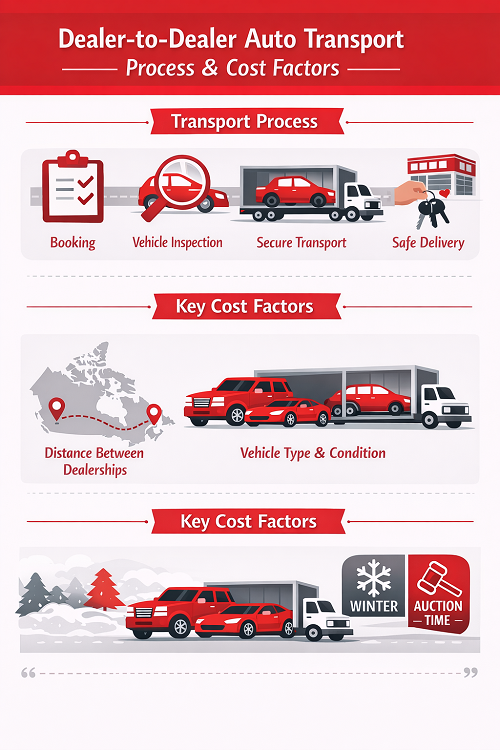
The transport services of a dealership vehicle is a set of an organized procedure that guarantees the safety of the vehicle and the efficiency of the operation. Trustworthy carriers, therefore, go through the steps, which are clearly outlined from the booking to the delivery, thus, lessening the dangers of a long-distance transport.
Key Factors Influencing Transport Costs
Pricing changes depending on a few major factors:
Distance Between Dealerships:
A long distance will fuel more consumption, time, and planning of the logistics.
Vehicle Type and Condition:
If a vehicle is oversized, heavy, or a special type, it will probably have to go in an enclosed carrier or will have to be handled more.
Seasonal Market Demand:
A winter storm or a peak auction period may cause the prices to rise and the number of available products to drop.
Step-by-Step Breakdown of the Dealer Transport Process
1. Booking and Scheduling:
The dealership lists out details like where the pickup will be, the destination, the type of vehicle, and the timeline required. After that, the carrier schedules the pickup.
2. Pre-Transport Inspection:
Drivers take pictures of the vehicle’s exterior to make sure the record is accurate and give both parties safety.
3. Loading and Transit:
The vehicles are tied securely to the trailers by using the approved tie-down methods. Drivers take the routes which are planned most efficient to reduce the risk and delays.
Dealer To Dealer Auto Transport Canada is putting the principles of first of all safety, efficiency, and communication. Professional carriers keep the Car dealership staff informed on a regular basis by interaction and they also give them updates during the whole transit time.
Comparison, Real Examples and Cost Visualization
By comparing different transport options, dealerships get to know what kind of service they need. Open carriers are still the industry standard for most dealer shipments. Enclosed carriers are used to protect luxury units or to keep the inventory safe from any kind of damage. Door-to-door service is there to give the users more comfort.
Real scenarios help to clarify these decisions. A dealership group which is moving the inventory between the branches in Ontario is using open carriers for multiple vehicles. A luxury dealership that is sending a high-end model to a partner location in British Columbia is choosing enclosed Car shipping.
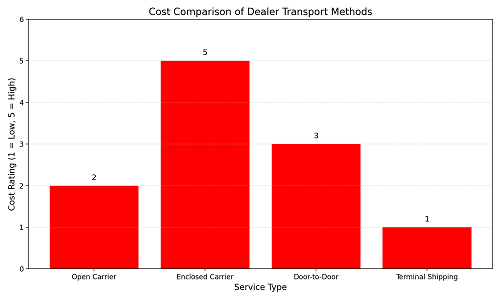
- Enclosed Carrier has the highest cost rating (5/5), making it the most expensive dealer transport option.
- Terminal Shipping is the lowest cost rating (1/5), best suited for strict budget moves.
- Door-to-Door sits in the mid-range (3/5), balancing cost with convenience.
- Open Carrier is relatively affordable (2/5) and is often used for standard dealer inventory.
These comparisons help to clarify the price differences and allow dealerships to match their needs with the most suitable service. Dealer To Dealer Auto Transport Canada is your go-to for anything support-wise, that is from individual unit transfers to bulk inventory movements. Balancing cost and protection is what allows dealership logistics to be efficient.
Practical Tips for Selecting the Best Carrier and Getting Inventory Ready
Dealerships are the beneficiaries of streamlined transport protocols and solid relationships with professional carriers. Planning ahead, communicating, and preparing will lessen the chances of having delays and will keep the vehicles safe.
How Dealerships Should Prepare Vehicles Before Shipping:
- Take off dealer plates and any personal items.
- Make sure the vehicles are clean for accurate inspection.
- Check if the battery is fully charged and the tires are properly inflated.
- Record the vehicle conditions through photos.
Moreover, dealers need to coordinate the timing with sales teams, service departments, and auction schedules. Proper communication will help to prevent overcrowding, make loading go smoothly, and increase the flow of work. Large shipments should be scheduled in a way that allows for less downtime and better cost control.
Final Recap
Dealer To Dealer Auto Transport in Canada is a must for the smooth functioning of dealerships by Canadian Car Shipping. Through it, dealerships can manage their inventories, pick up goods from auctions, facilitate local branch exchanges, and adjust for seasonal demand changes. The current roadmap has outlined the operations, cost factors, service comparisons, preparation tips, and necessary considerations.
Open carriers are a good and fair-priced choice for the majority of dealer shipments. Enclosed carriers are used when the inventory is of high value, and hence the need for protection, while both door-to-door and terminal services have some characteristics in common and, at the same time, give different advantages to users.
